Jada Stanley—Mr. Stanley
The ExceptionJada Stanley’s relationship with her father, Thomas Stanley, is marked by affection, concern, and an effort to respect her independence. He notices when she is troubled, offers safety and a place in her professional life without demanding explanations, and remains a source of emotional steadiness. His suspected heart attack makes that bond newly urgent: at his hospital bedside, his regrets about time spent working and family grievances become advice to Jada and Kari to choose what makes them happy.
A Close Bond with Room for Silence
Mr. Stanley addresses Jada with affectionate familiarity, calling her his girl and later welcoming her and Kari as his daughters. Their closeness appears not as constant disclosure but as attentive care. Before her father becomes ill, he tells Jada he knows something is happening with her but will not push her to talk. Instead, he asks her to be safe and check in from time to time. His response recognizes her distress while leaving her control over what to share.
That restraint matters because Jada has experienced serious harm in her marriage to Decker without confiding in anyone. At one point, she says that neither Kari nor her friends know what she has endured. The account does not establish that her father knows the details either. His later recognition that something is wrong suggests attentiveness, but he does not claim knowledge he has not been given. The relationship is therefore intimate without being presented as all-knowing: care takes the form of noticing, asking, and allowing Jada space.
Family Care and Professional Support
Their connection also overlaps with Jada’s work. In a conversation with her father, she tells him that Simon Powers is a prospective buyer for Solomon Place and that he has made an offer. Elsewhere, Cane Alexander speaks to Mr. Stanley about reassigning Simon to another realtor, while acknowledging Jada’s good work. Together, these exchanges place the father-daughter relationship in a professional setting as well as a family one: Mr. Stanley is involved in decisions affecting Jada’s work, and her competence is recognized in that context.
When Jada is preparing to leave, her father acknowledges that she has not worked long enough to guarantee that he must hire her back when she returns, but says the odds are in her favor. The qualification makes his support practical rather than absolute; he does not promise a result the circumstances do not assure. Yet he expresses confidence in her prospects, and his encouragement sits alongside his more personal request that she stay safe and keep in contact. The exchange presents support as both emotional care and an attempt to help her retain a future of her own.
Illness Brings Their Priorities into Focus
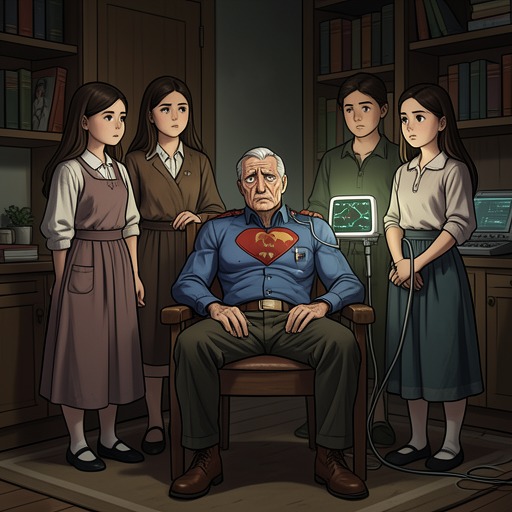
The possibility of losing that future together becomes immediate when Kari calls to say that their father has been admitted to Mary Sherman Hospital and may have suffered a heart attack. Jada has just landed at Sky Harbor with Kari when the hospital news reaches them. They go to his room, where he lies asleep with an oxygen tube and monitors attached. Seeing him pale and weakened, Jada instinctively takes Kari’s hand. The sisters’ shared gesture makes their worry visible before either can resolve it in words.
When Mr. Stanley wakes, he tries to move toward his daughters but gives up, then greets them warmly. Jada goes to his bedside and asks how he feels; he answers honestly that he feels terrible and asks whether she came all the way home because of his condition. She confirms that she was worried. Their exchange turns his illness into a direct measure of their attachment: his concern includes the cost of her return, while her presence makes clear that seeing him matters more than avoiding the trip.
Regret, Advice, and Reciprocal Affection
Holding Jada’s hand and looking toward both daughters, Mr. Stanley reflects on how quickly life can end and on what he wishes he could redo. He regrets spending too many hours in the office, allowing Jada and Kari’s mother to go to bed angry over small matters, and becoming irritated by the girls’ scattered doll shoes when they were young. These recollections are specific domestic memories, not abstract lessons. He frames them as wasted energy and urges his daughters to make happiness a priority while they can.
The hospital scene does not erase the earlier distance around Jada’s private troubles, nor does it resolve every family difficulty. Instead, it shows care moving in both directions: her father offers hard-won counsel, and Jada and Kari stay with him until a nurse reminds them that visiting hours are over. Jada kisses him goodnight, promises to see him in the morning, and leaves after he tells both girls that he loves them more than anything. Their bond is defined by this combination of tenderness, practical concern, and belated understanding of how easily ordinary time can be lost.